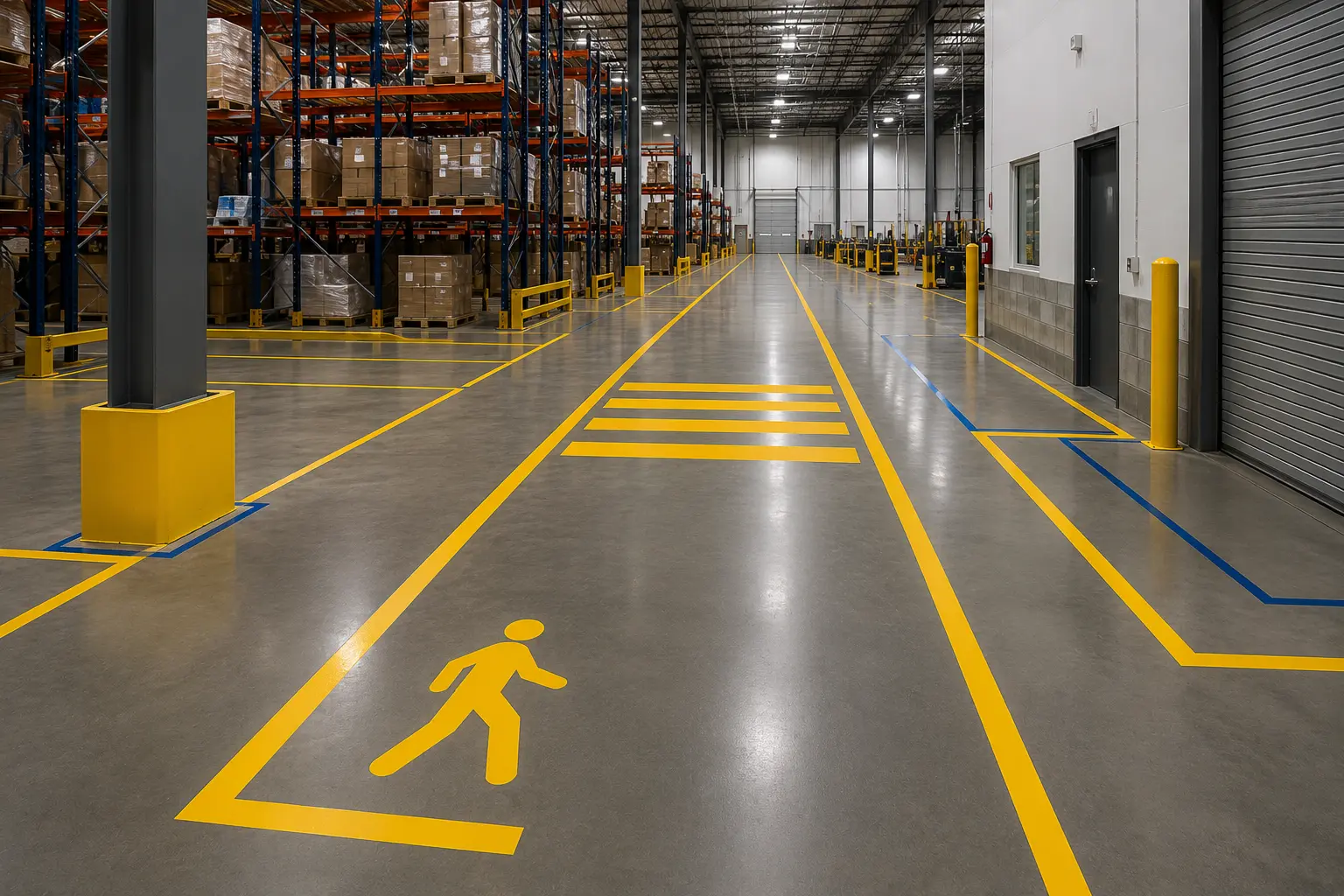
Forklift Traffic Without Clear Lanes?
Clear forklift lanes and safety-zone markings keep warehouse floors organized and reduce the chance of a serious accident.
Warehouse and industrial floors carry different traffic than a parking lot — forklifts, pallet jacks, foot traffic, and staged inventory all sharing the same open space — and without clear markings, that mix is where serious accidents happen. Floor striping defines forklift lanes, pedestrian walkways, staging and storage zones, and safety areas around equipment, giving everyone on the floor a visual system for where they’re supposed to be.
We stripe warehouse and industrial floors for Wichita’s manufacturing, distribution, and logistics facilities, using durable floor-marking paint or tape systems built to hold up under forklift traffic and heavy foot traffic. Layouts are planned around how the facility actually operates — pallet flow, staging areas, equipment clearance zones — not just a generic grid applied without understanding the workflow.
An unmarked warehouse floor puts the burden on every forklift operator and every pedestrian to guess where they’re supposed to be, every time. Clear floor striping removes the guesswork: forklift lanes stay separated from pedestrian walkways, staging areas don’t creep into traffic lanes, and equipment clearance zones stay visibly clear. Wichita’s manufacturing, aerospace, and logistics facilities run serious forklift traffic volume, and floor marking is one of the more cost-effective safety investments a facility can make relative to the cost of a single accident.
We assess how the floor is actually used — pallet flow, forklift routes, staging areas — before planning any layout.
Clear lane striping that separates forklift traffic from pedestrian walkways and staging zones.
Marked walkways that keep foot traffic visibly separated from equipment lanes.
Striping around fixed equipment, electrical panels, and other areas that need to stay clear.
| Pricing factor | How it affects your estimate |
|---|---|
| Lot size & scope | Larger lots and multi-visit contracts change per-unit pricing. |
| New layout vs. restripe | New layouts require full measurement and planning work. |
| Specialty markings | ADA stalls, fire lanes, and stencils are priced per unit/linear foot. |
Warehouse floor striping is typically priced by total square footage and layout complexity — a simple lane-and-walkway layout costs less than a full facility plan with multiple zones, staging areas, and custom markings. We’ll walk the facility and give you a written estimate based on the actual layout needed.
We plan floor layouts around how a facility actually operates, not a generic template — because a forklift lane that doesn’t match real pallet flow just gets ignored, the same way a parking lot’s markings get ignored when they don’t match how people actually drive. The same laser-guided precision we use on outdoor lots applies indoors, so lanes stay straight and consistent across a large facility floor.
No pressure, no obligation — just a straightforward look at your property.
We walk the facility and observe how forklift and pedestrian traffic actually move through the space.
We plan the layout — lanes, walkways, staging areas, and safety zones — based on real workflow.
We apply the markings using durable floor paint or tape systems built for heavy equipment traffic.
We document the finished layout with photos for your safety records.
No clear separation between forklift and foot traffic, staging areas that drift into travel lanes over time, a facility that’s never had formal floor markings, or a recent near-miss involving equipment and foot traffic are all signs it’s time for a floor marking plan. This is especially worth prioritizing ahead of a safety audit or after any change in facility layout or workflow.
Wichita’s manufacturing, aerospace, and logistics sector has grown steadily, and floor marking has grown with it as more facilities formalize safety programs and prepare for audits. Whether it’s a distribution center organizing pallet flow for the first time or an established manufacturing floor refreshing markings that have worn thin under years of forklift traffic, the underlying need is the same: a floor that tells everyone on it, at a glance, where they’re supposed to be.
It depends on the facility — paint holds up well for most industrial floors, while tape systems can be a faster option for facilities that need to reconfigure layouts periodically. We’ll recommend what fits your facility.
It varies by traffic volume and floor type, but durable industrial floor paint generally holds up well under regular forklift and foot traffic for a few years before needing a refresh.
Most floor striping can be scheduled in sections or during off-hours to minimize disruption to ongoing operations — we’ll work out a schedule that fits your facility.